
Solar System Not Producing What Was Promised? Check the Design First
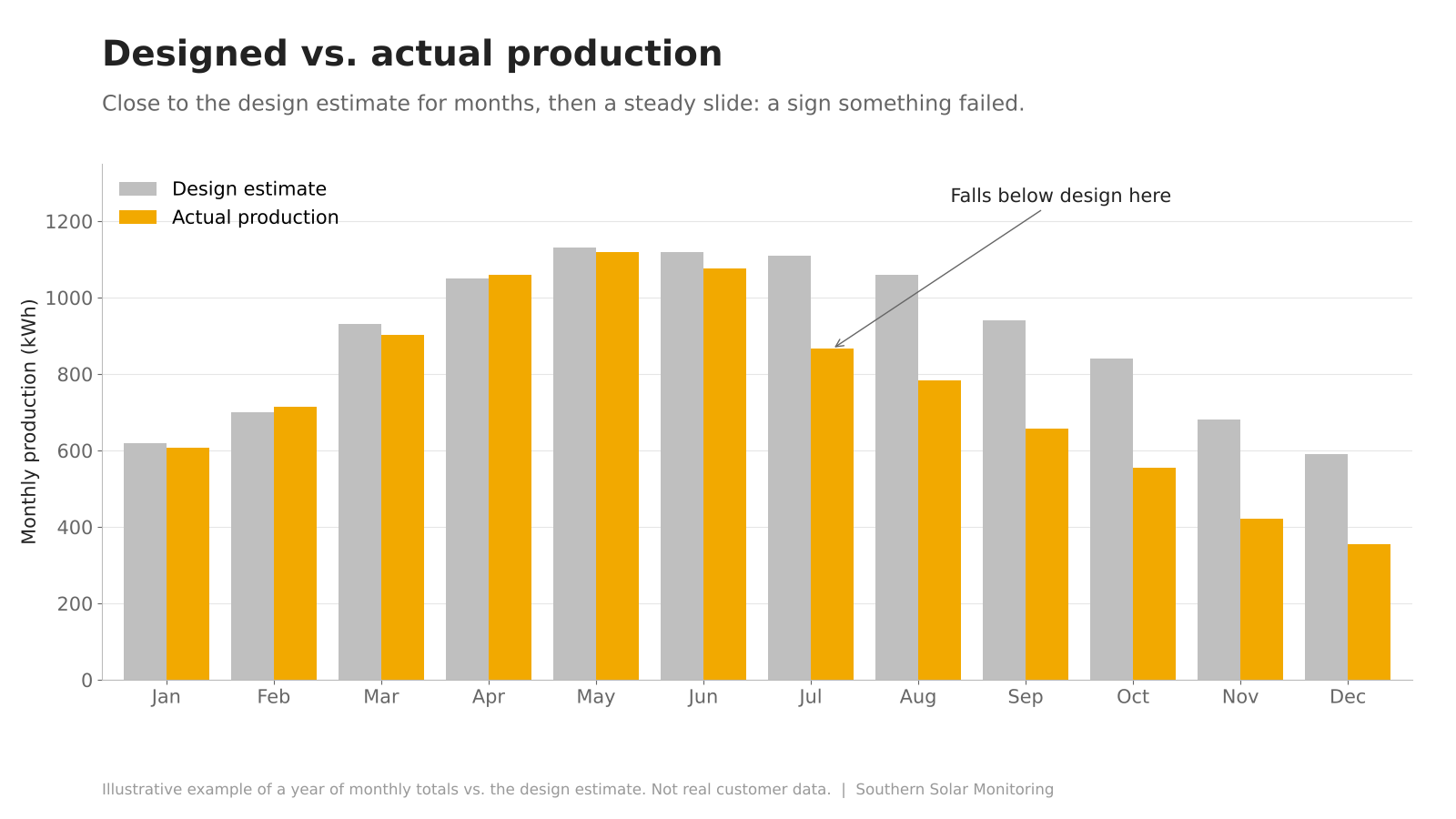
If your solar system isn't producing what you were promised, the first question is simple: is it underperforming its design, or did the sales pitch overpromise? Those are two different problems, and they have two different fixes.
What you were promised vs. what it was designed to do
The design is engineering. Before install, someone modeled your roof's direction, tilt, shade and local weather to estimate how many kilowatt-hours (kWh) the system should make in a year. That number is usually in your contract or proposal as "estimated annual production."
The promise is the sales pitch: "Your bill will be close to zero." "This covers 100% of your usage." "You'll save $40,000."
Solar sales runs on commission, and some salespeople will say whatever closes the deal. They inflate savings, assume your usage never changes, and quote production your roof can't support. So a system can be working perfectly and still miss what you were told.
Why the difference matters
| What you see | What it usually means | Who can fix it |
|---|---|---|
| Production well below the design estimate | An equipment problem | A solar service tech |
| Production matches the design, but the bill is higher than promised | The sales promise was off, or your usage or rates changed | Not a repair |
| Production suddenly drops to zero | Inverter, optimizer or breaker failure, or a dropped connection | A solar service tech, fast |
| You don't know what it's producing | Nobody is watching it | Monitoring |
How to check your system in 5 minutes
- Find the design number in your contract (annual kWh).
- Open your inverter's app (SolarEdge, Enphase, Tesla, etc.) and look at the last 12 months of production.
- Compare. Within about 10% of the design estimate means the equipment is likely fine. Well below it means something is wrong.
If the app hasn't updated in weeks, that's a problem by itself. Many systems quietly go offline and owners don't notice for months.
Illustrative example. A system that tracks its design for months, then slides below it, usually has a failed part.
If production is low
Most causes are fixable: a failed inverter, a bad optimizer or microinverter, a tripped breaker, a lost internet connection, or new shade. Parts are often still under manufacturer warranty, even if your installer went out of business.
If the promise was the problem
We can't change what you were told. No repair fixes a sales promise. If that's your situation, document your production and contract numbers before talking to your installer, lender or an attorney.
What we can do is make sure your system does what it was designed to do.
Keep your system doing what it was designed to do
Southern Solar Monitoring checks your system every day and alerts you when production drops below where it should be. When something breaks, our techs repair it, so your system keeps producing what it was built to produce. Our Basic plan is free forever and works with SolarEdge, Enphase, Tesla, Generac and more, including systems whose installer has closed.
FAQ
How do I know if my solar panels are underperforming? Compare the last 12 months of production in your inverter app to the annual estimate in your contract. More than about 10% below is worth a look.
Why is my electric bill higher than the solar company promised? Usually higher home usage, utility rate or billing changes, or an overly optimistic sales proposal, not broken equipment.
Is my warranty still good if my solar installer went out of business? Manufacturer equipment warranties usually still apply. The installer's workmanship warranty typically ends when the company closes.